
Sentiers du Patrimoine ®
Commeny
Revenir au centre du village, passer la mairie et prendre à gauche la rue du stade pour voir le panneau sur les anciens commerces.
Prochain point : Lat. 49.12646, Long.1.89142
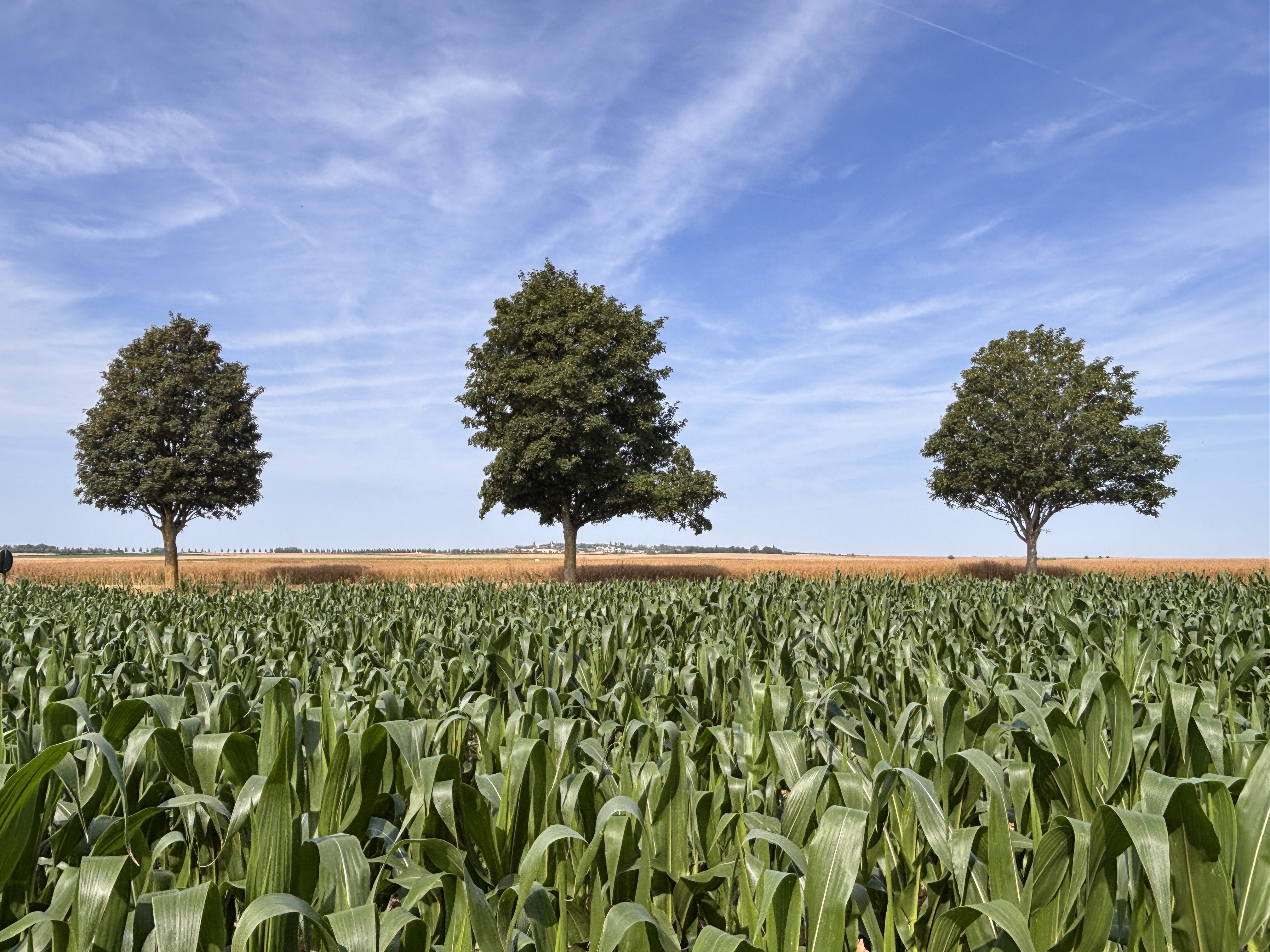
Apart from the Gouline ravine, the entire territory of the commune lies on the central plateau of the French Vexin.
Its particularly fertile soils have been cultivated since Antiquity, mainly for cereal farming, creating the vast open landscapes known as open fields. At the end of the 19th century, the main crops grown in Commeny were wheat, oats and sugar beet. The area also included many meadows, as well as watercress beds in the Gouline ravine.
On the horizon, only valleys, wooded hills, grain silos and church spires interrupt the sweeping views across the plateau.
The 1831 cadastral map of Commeny shows numerous important routes crossing the village, including roads leading to Gisors, Pontoise, Meulan, Magny and Marines.
In addition, the place name La Porte de Mantes, shown on the boundary with Guiry, suggests that Commeny was once connected to the Seine valley. This convergence of routes indicates that the village may have held a certain importance during the medieval period, serving as a stopping point for travellers moving between the major local towns and surrounding urban centres.
Several wayside crosses still mark former important crossroads, including the one to the north between the routes to Gisors, Nucourt and Tillay, and the one to the south between the routes to Les Bruyères, Meulan and Pontoise.
This ancient road, built in the 1st century AD and abandoned during the Middle Ages, linked Paris to the English Channel via Pontoise and Rouen over a distance of 190 kilometres.
Its remarkably straight route across the plateau can still sometimes be identified by hedgerows and isolated trees. At Commeny, it is interrupted by the RD159, beside which the only visible cross-section of the road can be found.
This section reveals the impressive width of the road and the different layers that made up its construction. Beyond being a route for travellers, the road was also a place of activity, lined with workshops, stopping places, inns, small cemeteries and perhaps even houses.